On July 15, 2021, Science in Parallel launched a six-episode season celebrating the 30th anniversary of the Department of Energy Computational Science Graduate Fellowship program. After five years, 45 episodes and 55 guests, we’re taking a look back at our coverage of computational collaboration and creativity, exploring research on energy, medicine, artificial intelligence, quantum science and more.
You’ll meet:
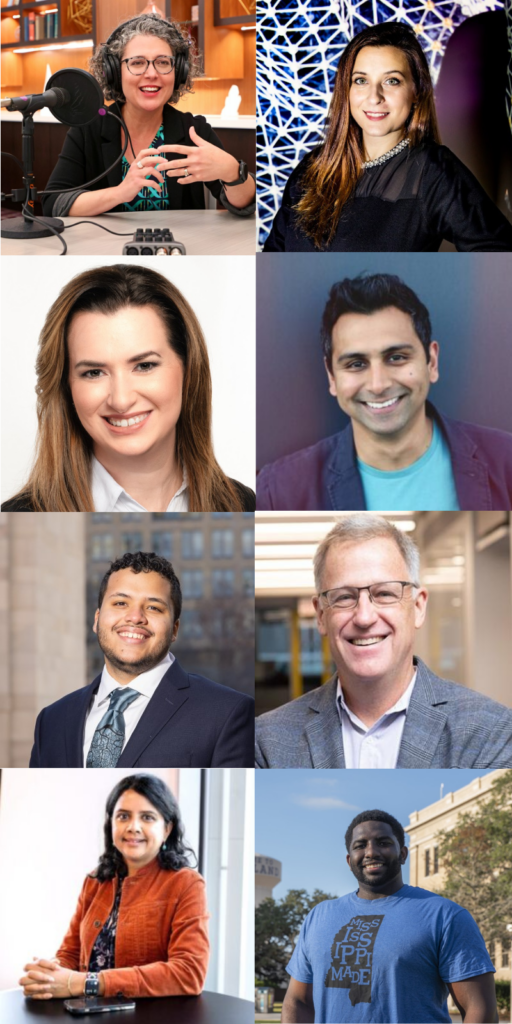
- Sarah Webb: Science in Parallel’s host
- Anda Trifan: Senior Principal Scientist, GSK
- Amanda Randles: Professor of Biomedical Engineering, Duke University
- Anubhav Jain: Chemist/Staff Scientist/Engineer, Lawrence Berkeley National Laboratory
- Danilo Perez: Ph.D. student at New York University
- Ian Foster: Professor of Computer Science, University of Chicago, and Senior Scientist, Argonne National Laboratory
- Sunita Chandrasekaran: Associate Professor of Computer and Information Sciences, University of Delaware
- Quentarius Moore: Software Development Engineer, AMD
From the episode:
This anniversary episode includes clips from six past episodes and one talk that’s available on YouTube.
- Season 2, Episode 6: Pushing Limits in Computing and Biology
- Season 6, Episode 5: Amanda Randles: A Check-Engine Light for the Heart
- Season 4, Episode 4: Anubhav Jain: Hacking Materials
- Season 4, Episode 3: Danilo Pérez: Embracing Versatility
- Season 6, Episode 1: Ian Foster: Exploring and Evaluating Foundation Models
- Season 6, Episode 10: Sunita Chandrasekaran: Computation in Translation
- “Enabling Excellence: Optimizing GPU Applications, AI Workloads, and Supporting the HPC Community” presented by Quentarius Moore at the 2024 DOE CSGF Annual Program Review.
Other episodes mentioned:
- Season 1, Episode 3: Quentarius Moore: Ask Questions and Apply for Everything
- Season 6, Episode 8: Youngsoo Choi: Building Reliable Foundation Models
- Season 6, Episode 9: Silvia Crivelli: Understanding Suicide Risk and Building a Foundation Model for Medicine
Transcript
Transcript prepared using otter.ai with human copyediting
Sarah Webb 00:03
Five years ago this month we released the very first episode of Science in Parallel.
Sarah Webb 00:10
Hello, I’m your host Sarah Webb, and this is Science in Parallel, a new podcast about people and projects in computational science. In this season…
Sarah Webb 00:20
in that first season, we celebrated the 30th anniversary of the Department of Energy Computational Science Graduate Fellowship, the CSGF. That program continues to support this podcast, and our show highlights researchers using their skills across computer science, applied math, science, and engineering to solve important problems in energy, medicine, quantum science and more.
Sarah Webb 00:54
We started Science in Parallel with the goal of sharing computational science stories in a way that allows you to hear from the researchers directly and in depth. These conversations don’t just dig into data and results. Scientists talk about their hows and whys, their strategies for solving important problems, and what motivates them each day. We are talking about where computing and human innovation meet, and what that means for society. That’s led to seven seasons with 45 episodes and 55 guests. And in this episode, we’ll look back at the themes that we’ve covered in this rapidly moving period when exascale computers were deployed, AI became ubiquitous, and quantum error correction is improving.
Sarah Webb 01:49
This podcast launched in 2021 as the Department of Energy was wrapping up the exascale computing project. Oak Ridge National Laboratory’s Frontier System was officially deployed in 2022. It was followed by El Capitan at Lawrence Livermore National Laboratory and Aurora at Argonne National Laboratory. All three systems remain among the fastest machines in the semiannual Top500 list that was announced in June 2026, just before I recorded this episode.
Sarah Webb 02:23
That added computing power was important in 2020 as the COVID 19 pandemic took hold. Detailed computational models of the SARS-CoV-2 virus gave researchers vital information for developing vaccines and therapies. In our season two finale in October 2022 we talked with Anda Trifon, who at that time was completing her Ph.D. at the University of Illinois Urbana-Champaign. Anda talked about what it was like to work on such an important problem during a crisis.
Anda Trifan 03:01
I did my first practicum with Arvind Ramanathan at Argonne National Lab in 2020 and I was supposed to finish in April and in March. the pandemic hit, and so, of course, as with everybody else, everything just kind of dropped, and everybody started working on coronavirus-related things. And this was a week before my practicum ended, so technically I could have just left, but I was so curious about how the virus worked and why it’s so easily spreadable and why it’s so dangerous and how it affects all of our organs. And so none of that was known at the time.
Anda Trifan 03:42
We know of SARS-CoV, the original one, and MERS, but this one has such high infectivity rate, and I was really curious about how this is different and why. And so I asked Arvidn to join his coronavirus projects right away, and he was like, “Yes, of course we can use all the hands that we can get.” So I started working on smaller systems first with COVID. There are two main proteases: there’s Mpro and PLpro. I worked on the smaller one. This one kind of cuts up the viral RNA, and then it translates it into the subsequent proteins that need to be used in the viral replication cycle, but aside from that, we got involved with Rommie Amaro’s lab, who built the first virus system, and we also collaborated with Lillian Chong’s lab from Pittsburgh, and they do this enhanced molecular dynamics method called WESTPA, weighted ensemble simulations. Lillian’s lab studied the spike protein and specifically the open-to-close transition, and that’s very important, because as the first point of contact that the virus has with our ACE2 human receptors.
Anda Trifan 04:58
And so this open-to-close transition was very important in trying to figure out, you know, how exactly the virus binds first to ourselves, and so they did that part. And then Rommie’s lab did the full simulations of the spike, and then also did the simulations of the spike binding to the ACE2 human receptor, and what we in Arvind’s lab did was take all of that data and use machine learning to extract very relevant and important information from them. Because typically when you have hundreds of nanoseconds or microseconds of simulation, it’s very difficult to kind of sift through it visually or with any kind of analysis tools, and extract what might be interesting or relevant at a biophysical level. So everybody kind of played a different part in this project, and this led to our Gordon Bell submission, and eventually we won with that project in 2020.
Sarah Webb 06:07
In November 2022, not long after this episode was released, Anda took a position at GSK, where she is now a senior principal scientist.
Sarah Webb 06:18
That episode also featured Amanda Randles of Duke University. In 2025, I spoke with Amanda again about her ongoing work to model human blood flow, with the goal of creating forecasting tools that can zoom in to look at how individual cells move or follow blood flow over the whole human body over weeks or even months. Much of that work has been done on the DOE pre-exascale and exascale systems, including Aurora at Argonne National Laboratory.
Amanda Randles 06:54
Now, with Aurora, we can run that full body simulation only on a smaller portion of Aurora, which really allows us to run many of those simulations and do more exploratory science of like if you’re going to change heart rate or change the heart rate variability or other characteristics that we know are associated with disease development, can we do these parameter studies and see how they affect the pressure in the patients and really try to understand what’s going on with that patient. If we want to move to the digital twin side, where we’re trying to capture six months of time, we need tons of compute hours.
Amanda Randles 07:27
And then on the cellular components, we’re now with Aurora, we’ve been able to model at least a few billion red blood cells. It’s only a small fraction of the red blood cells in your body, but it’s a huge amount to really understand the interaction of billions of cells at a time, and really, you know, how a cancer cell might be moving through the body, where it’s interacting with the red blood cells, where it’s moving is really critical to capture these cell-cell interactions. And Aurora is allowing us to fully deformable red blood cells that are adhesive and really mimic the physiology of the system without having to make as many assumptions.
Sarah Webb 08:04
Amanda’s work, taking the fundamentals of modeling fluid dynamics and applying them to human blood flow, is just one example of the creativity involved in computational science research. And creativity was the driving theme throughout our middle seasons.
Sarah Webb 08:24
For example, Anubhav Jain of Berkeley Lab works on the Materials Project, an ongoing initiative to share information on known and predicted materials, molecules that could have useful properties for energy challenges and more. In our conversation, we discussed how creativity played out within a couple of his AI-focused projects, mining existing literature for interesting materials data and in visualizing the structures of new materials and how those might be connected with useful properties.
Anubhav Jain 09:01
To me, creativity is going outside the standard or expected operating procedure. So, for example, I mentioned that Vahe, who was the postdoc that was working on this natural language processing project, was looking at this data of materials that have this high dot product that were thermoelectric, but weren’t known as thermal electrics, and to me it’s a creative step to not do the standard thing, which is to say that these are error points, and to actually dig deeper, and to ask the question, like, is this maybe something more than that, is this a prediction?
Anubhav Jain 09:34
Similarly, this idea that we need a library to visualize crystal structures, and how can we design a library that allows us to explore these crystal structures in a way that is necessary and in a way that’s very powerful. That involves creativity as well, because you’re going beyond what the current visualizers can do, and you want to see what sorts of things might be possible. So, in this case, Matt Horton, who’s now working at Microsoft, was the one that was doing that particular project.
Anubhav Jain 10:00
Yeah, so I think anytime you’re maybe thinking beyond what’s the standard operating procedure from before, that is, you know, the creative part. And that’s certainly the fun part of being in science, because your whole goal is to go beyond what was done before. Your goal is not to replicate the things that were previously done. Your goal is to figure out new ways to do things, and so it’s certainly something where you get to exercise creativity very regularly.
Sarah Webb 10:28
Throughout these episodes. I asked my guests what creativity meant to them. Here’s what Danilo Pérez told me in 2023 He’s a Ph.D. student in neuroscience at New York University.
Danilo Perez 10:45
Versatility, I think that’s what it is. I think definitely there is a specialization that we come with. There’s a badge that we do want to put on. In my case, it’s neuroscience, it’s computational science. But being creative also means being flexible,. It’s not overspecializing; it’s not building out that great muscle. You have to also be able to work with it. And when I think of creativity, it comes straight back to the idea of versatility and amenability to the circumstances and problems that you’re posed,
Sarah Webb 11:20
Machine learning and artificial intelligence have come up throughout the podcast, but research in that area has exploded over the last five years. After the 2024 Nobel Prizes in physics and chemistry were awarded for both the underpinnings and an application of AI. We spent much of season six looking at AI for science. We talked about foundation models, both their development and how they could change workflows for scientists and engineers. In the first episode of that series, I spoke with Ian Foster, who is both a professor at the University of Chicago and a senior scientist at Argonne National Laboratory. He co-leads the data team working on AuroraGPT, a foundation model for science.
Sarah Webb 12:16
What makes large language models powerful, exciting?
Ian Foster 12:20
So a large language model, which is an example of a broader class of entity called a foundation model, is basically a large, general-purpose AI model trained on a very large and diverse data set. In the case of a large language model, the dataset is large quantities of natural language text. In the broader class of foundation models that also could include images and datasets and other sorts of information. These models are trained by a process by which, in an iterative manner, the values for billions of parameters are set in ways that allow them to predict the possible future outcomes of patterns in the data.
Ian Foster 13:04
And as part of that, they’re able to learn these sort of very rich internal representations of language, or could be, in the broader case, images, computer code, etc. And these internal representations then allow them to be adapted or fine tuned for a wide range of downstream tasks like text classification, question answering, image capture, computer coding, and so forth. And what you know is impressive about the foundation models, the large language models of today is that they seem to be able to address a very wide range of downstream tasks. It used to be you’d build a machine learning model for one purpose, and then you’d have to build a new one for another purpose, but we seemed about to use these most recent models for many different purposes, which is very exciting.
Sarah Webb 13:58
In that series, we also heard from Youngaoo Choi of Livermore, who talked about how to make foundation models more reliable, and I spoke with Silvia Crivelli at Berkeley Lab, who has been working on a nearly decade long project investigating how and if models could help improve human health, starting with U.S. veterans. We wrapped up that series with Sunita Chandrasekharan of the University of Delaware, talking about the layers of her computer science research. She leads an academic lab and a university institute, and she serves as a vice chair of Delaware’s state AI Commission. Even as someone immersed in AI, she discussed how rapidly that field is moving,
Sunita Chandrasekaran 14:52
Staying on top of state of the art research, you know, staying on top of what is the current state of the art in this space and. And what questions do they open to in the very near future is what we constantly think about, meaning: I have Ph.D. students and I need to make sure they are still in the game five years from now and they are graduating and out going out of the door, right? So, what does that mean? How does that look like? What are the GPUs I’m using? What are the CPUs I’m using what machines am I using? Am I up to date?
Sunita Chandrasekaran 15:23
I think that’s what I constantly keep thinking about, and that is also my constant advice to universities and whomever I’m speaking to within the academic environment. It’s important to not fall behind, especially in the AI space, and I feel like if I haven’t read up on at the end of the day on the day’s findings on AI, I feel like I’m, I’m several years behind. So, I think it’s important to stay up to date, that’s key. With the university trying to put new machines together and trying to bring new collaborations, and talking to domain scientists, meaning scientists working on different scientific domains. I think they help us drive some of those research questions that will in turn help them solve the problems, but it keeps us traditional computer scientists on our toes.
Sarah Webb 16:18
This year we’ve focused on quantum computing, a field that continues to attract excitement and investment across the DOE labs, industry, and academia.
Sarah Webb 16:29
Despite the unrelenting pace of technological change that we’re covering here on Science in Parallel, the people continue to shine through. In talking with our guests, I’ve learned about the others who’ve mentored and inspired them, and their interdisciplinary work in computing draws on human skills, communication, and collaboration as they solve problems.
Sarah Webb 16:57
Quentarius Moore was a guest during our very first podcast season, and in that first conversation, we talked about how particular people, his grandfather, his friend and mentor, Chris Copeland, and his Ph.D. advisor, James Batteas, helped shape his career. Since then, Quentarius has completed his Ph.D. at Texas A&M University in computational chemistry. He now works as a computational scientist at AMD, where he got his start as an intern. In that project, he worked on a sticky computational chemistry problem, getting quantum espresso software to work on AMD GPUs. He continues to support GPU and AI workflows for AMD clients, including the DOE national laboratories. In July 2024 Quintarius was recognized at the CSGF annual program review with a House Scholar Award, and in his talk he acknowledged the people who have guided his career path.
Quentarius Moore 18:08
I’ve always been fortunate enough to have these people come into my life who were just. I don’t know, there’s always different. They saw something that you didn’t see, and it made you just believe that you could do whatever you could do.
Sarah Webb 18:23
His journey highlights the space that we’ve staked out on Science in Parallel. We are shining a spotlight on the future through the stories of hard work, inspiration, and most of all, collaboration among our guests, alongside the research they continue to pursue. Thanks to all of them for sharing their time and their insights, and thanks to you, our listeners, for supporting the show for five years and counting.
Sarah Webb 18:50
Even though I’m the voice you hear on this podcast, it wouldn’t be possible without people behind the scenes who have kept us running over the last five years. Tess Hansen edited several episodes in seasons two and three, and Susan Valot has been editing our episodes since early in season six. She edited this episode, too.
Sarah Webb 19:13
Members of the Krell Institute’s IT team kept things humming on the web. Rob Pearson has managed technical issues, and Mat Wymore and Kat Gisi led the work on the scienceinparallel.org website, where you can find our show notes. Thank you!
Sarah Webb 19:36
Science in Parallel is produced for the Krell Institute and is a media project of the Department of Energy Computational Science Graduate Fellowship Program. Any opinions expressed are those of the speaker and not those of their employers, the Krell Institute or the U.S. Department of Energy. Our music is by Steve O’Reilly. This episode was written and produced by me, Sarah Webb.